

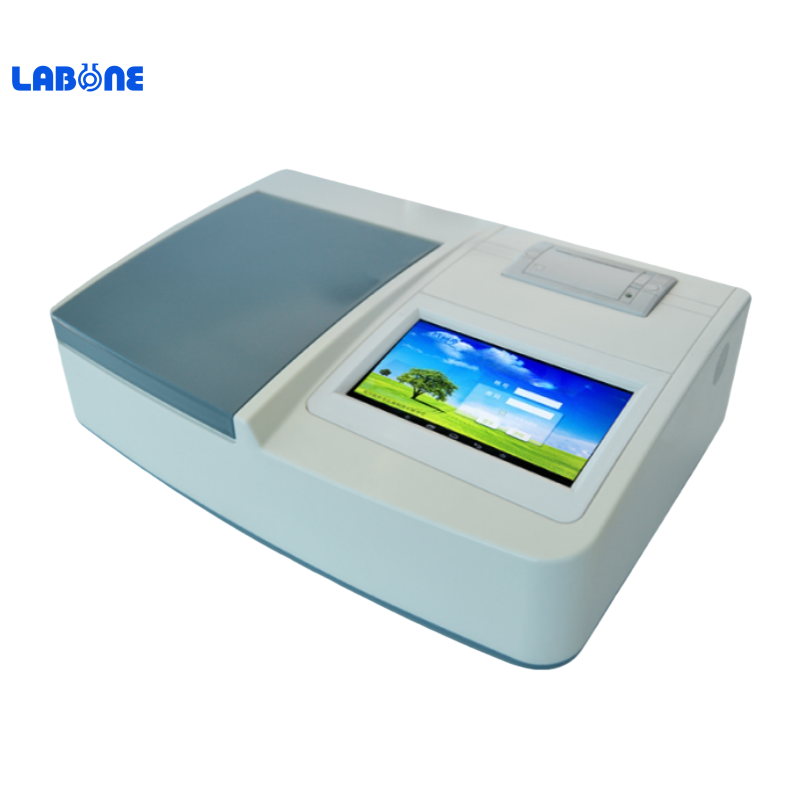
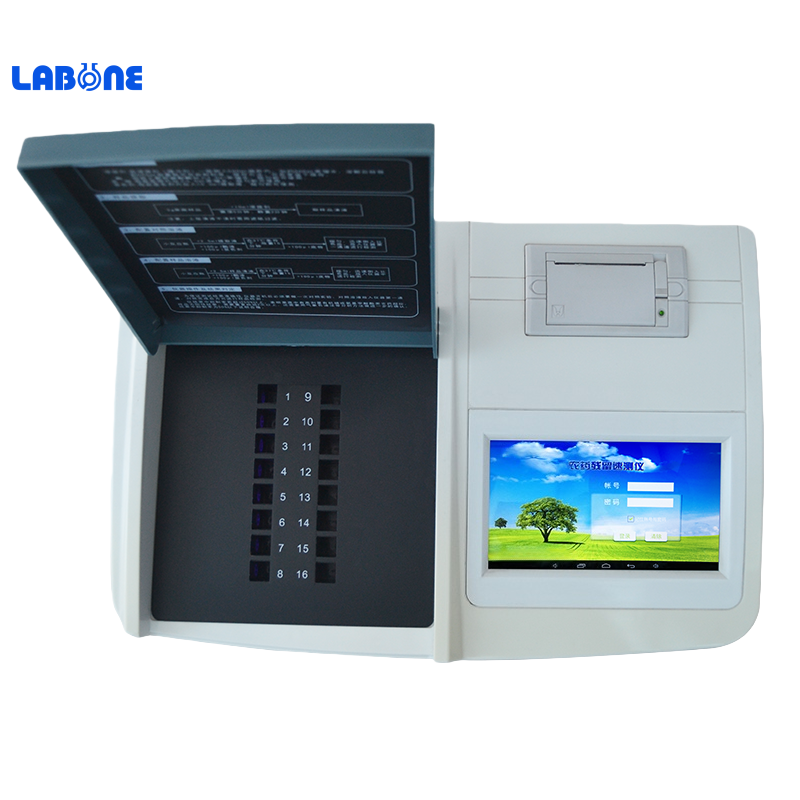
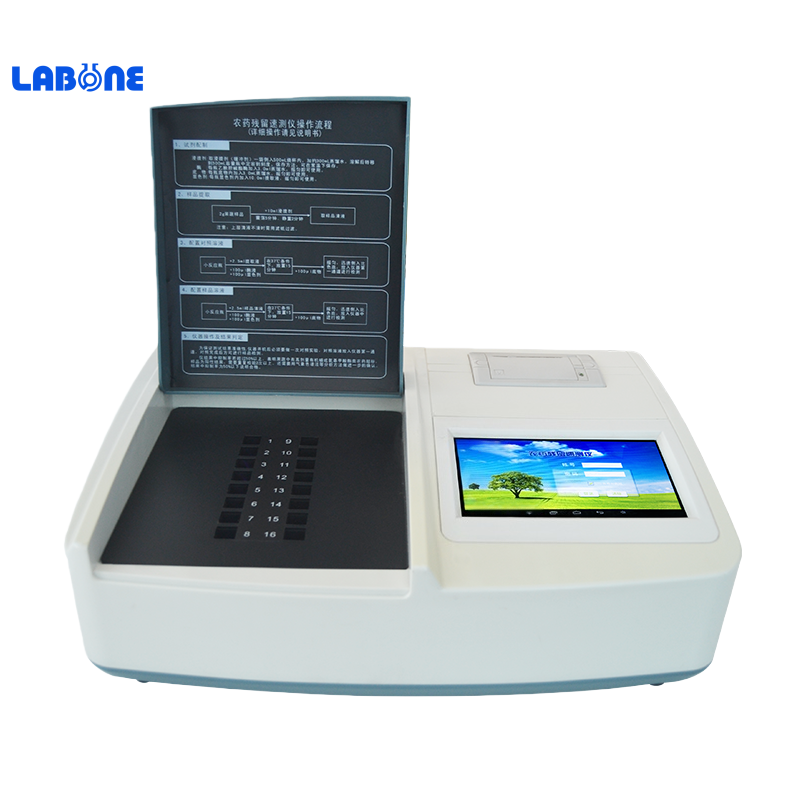
OK-C16 Pesticide Residue Rapid Tester
I. Product PrincipleBased on the insect toxicology principle that organophosphates and carbamates inhibit the activity o
I. Product Principle
Based on the insect toxicology principle that organophosphates and carbamates inhibit the activity of acetylcholinesterase in the central and peripheral nervous systems of insects, leading to the accumulation of the neurotransmitter acetylcholine and affecting normal conduction, thus causing insect poisoning and death, this principle is applied to the detection of pesticide residues. If the vegetable extract does not contain organophosphates or carbamates, or the residue level is low, the enzyme activity is not inhibited, and the substrate added in the test is hydrolyzed by the enzyme. The hydrolysis products react with the added chromogenic agent to produce color. Conversely, if the vegetable extract contains a certain amount of organophosphates or carbamates, the enzyme activity is inhibited or partially inhibited. The substrate added in the test cannot be hydrolyzed by the enzyme, or is only partially hydrolyzed, resulting in no color development or very little color change. By measuring the change in absorbance over time using a spectrophotometer and calculating the inhibition rate, the presence of organophosphates or carbamates in the vegetables can be determined.
II.Test Items
Pesticide residues in fruits and vegetables.
III. Performance Characteristics
1. Both qualitative and quantitative test results are possible. Qualitative results are displayed as inhibition rate, and quantitative results are displayed as mg/kg.
2. 7-inch extra-large LCD backlit display screen, Android system for easy operation and convenient upgrades.
3. Built-in GPS module (built-in, no external antenna required), real-time positioning of latitude and longitude, accuracy within 5 meters.
4. Built-in high-speed thermal printer (no need to replace ribbon) can print barcodes, vegetable names, inhibition rates, pesticide content (quantitative), pass/fail status, test date, and testing unit (can be modified on the main unit), all in Chinese.
5. The instrument main unit can set ≥105 vegetable and fruit names.
6. The instrument performs a self-test of the light source upon startup, eliminating the need for manual adjustment with light blocks.
7. Can store ≥180,000 test records, with automatic data saving function; stored data is not lost after power failure, and has comprehensive query and statistical functions.
8. Reaction time and upper limit of pass/fail standards can be set on the main unit.
9. Simultaneously measures 16 samples, either simultaneously or individually. The main unit has a built-in mini printer, which can summarize and report pesticide residue data to the agricultural monitoring information system.
10. Data query: Data can be viewed by test date and test number, and stored measurement data can be deleted. Functions include single-line deletion, all deletion, printing, forward/reverse sorting, sorting by item name, and filtering by date.
11. Features voice guidance and broadcasting functions, with Chinese and English switching.
12. The main unit comes standard with test environment parameters, including air temperature, humidity, and dew point. Environmental parameters can be connected simultaneously or individually to the main unit (optional).
13. Allows for remote network program updates without returning to the factory.
14. Equipped with RJ45/WIFI/USB interfaces.
IV. Technical Parameters
1. Number of Channels: 16 channels.
2. Wavelength: 412nm.
3. Inhibition Rate Display Range: 0~100%.
4. Inhibition Rate Measurement Range: 0~100%.
5. Transmittance accuracy: ≤±1.5%.
6. Transmittance repeatability: ≤0.5%.
7. Photocurrent drift: ≤0.5% (3 minutes).
8. Pesticide detection limit: 0.1~5mg/kg.
9. Inhibition rate repeatability: ≤5%.
10. Detection time setting: 0~9min (arbitrary setting).
11. Working environment: Room temperature 20℃, humidity less than 85%.
12. Shock resistance: Qualified.
V. Product Configuration
Instrument case: Main unit, electronic balance, cuvettes, pipettes, power cord, etc.
Reagent case: Erlenmeyer flasks, volumetric flasks, funnels, graduated cylinders, reaction flasks, aluminum boxes, wash bottles, 1 set of reagents, etc.
Send Request
You may also like