

Rotary Evaporator Buying Guide
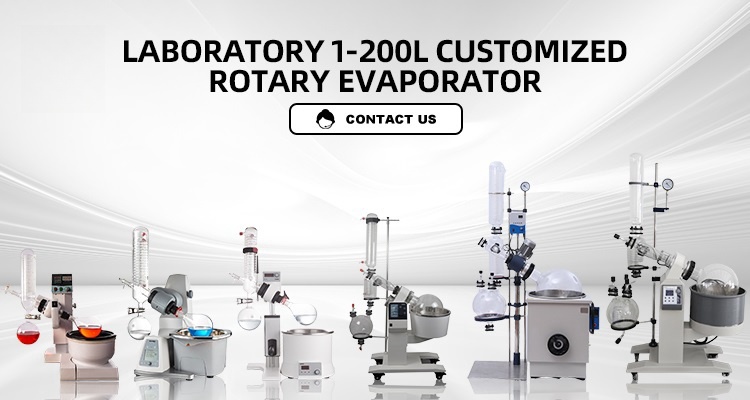
Rotary Evaporator Buying Guide
Dilution blow-off? Distillation efficiency too slow? Vacuum pump leakage, heating pot heating too slowly? Many of you have likely encountered these troublesome problems. So how can we avoid them?
Today, we'll share some experience, starting with avoiding these issues from the very beginning of choosing a rotary evaporator.
Before purchasing a rotary evaporator, ask yourself the following questions: What is the distillation volume per cycle? Approximately how many samples will need to be distilled per day? What solvents are expected to be used for distillation? What is the approximate boiling point range of the solvents? Are these solvents flammable, explosive, or toxic/hazardous? Once you've determined the experimental requirements and the types of solvents to be distilled, you can begin selecting a rotary evaporator!
1. Determine the Specifications of the Rotary Evaporator: Rotary evaporators are typically distinguished by the volume of the evaporation flask. The required flask size depends on the quantity of material to be evaporated. Generally, 2L, 3L, and 5L rotary evaporators are suitable for small-scale laboratory experiments; 5L, 10L, and 20L are suitable for pilot-scale tests; and 20L and 50L are suitable for both pilot-scale and production. Of course, in special cases, a continuous feed tube can be used to increase the evaporation flask volume, thereby increasing the continuous distillation volume to some extent.
2. Determine the Distillation Task to be Performed by the Rotary Evaporator: Distillation efficiency is crucial. The distillation efficiency of the rotary evaporator determines the number of samples that can be distilled per day. With the same solvent, higher distillation efficiency results in more samples being distilled. If the sample volume is large, more attention needs to be paid to considering distillation efficiency.
Key Factors Affecting Distillation Efficiency
NO. 1 [System Vacuum Value]
The sealed space of a rotary evaporator consists of glass components such as the evaporation flask, evaporation tubes, sealing rings, and condenser, as well as a vacuum buffer flask, vacuum pump, and vacuum tubing. Among these, the most critical and variable factors affecting the system vacuum are: the vacuum pump, sealing rings, and vacuum tubing.
Vacuum Pump and Vacuum Controller: The lower the vacuum pump's limit, the lower the system vacuum value. During distillation, a reasonable vacuum value needs to be set using a vacuum controller to ensure distillation efficiency while preventing bumping. Currently, the ultimate vacuum of diaphragm vacuum pumps can reach as low as 2 mbar, while the ultimate vacuum of circulating water pumps is approximately 50 mbar (0.095 kPa).
If the budget allows, a vacuum controller or vacuum valve is essential, as it controls the system vacuum value required for distillation.
Sealing Rings: As a key sealing component connecting the evaporation tubes and condenser, their wear resistance and corrosion resistance are crucial. Commonly used materials for sealing rings are PTFE and rubber; obviously, PTFE has better wear resistance and corrosion resistance. Some manufacturers add stainless steel buffer springs to the sealing rings for better wear resistance. Vacuum tube material: Generally, manufacturers do not include vacuum tubes as standard. When purchasing them yourself, silicone tubes are naturally the first choice because they age more slowly than rubber tubes.
NO.2 [Heating Pot Temperature]
The higher the heating pot temperature, the faster the solvent distillation. However, considering the heat sensitivity of the target component and operational safety, the most commonly used temperature is 60°C. Furthermore, above 80°C, using silicone oil as the medium can lead to cleaning issues; generally, lowering the vacuum value is recommended to achieve faster distillation efficiency.
NO.3 [Evaporation Flask Rotation Speed]
The faster the evaporation flask rotates, the larger the surface area wetted inside the flask, resulting in a larger heated area; however, the liquid film thickness also increases, increasing the temperature difference for heat transfer. There is an optimal rotation speed for materials of different viscosities. The rotational power is provided by a motor. DC brushless motors, AC motors, and stepper motors are available on the market, with varying quality. DC brushless motors offer the best feedback and require no maintenance for 10 years.
NO.4 [Temperature of Cooling Medium]
To ensure optimal distillation efficiency, it is generally recommended that the cooling medium maintain a temperature difference of 40°C from the heating pot to facilitate rapid condensation of the hot vapor and reduce its impact on the system vacuum. Safety Risk Assessment: The safety risks of distillation mainly stem from the distillation solvent and the heating medium.
1) If the heating medium is silicone oil, its flash point should be at least 25°C higher than the maximum temperature of the heating pot.
2) If the distillation solvent is flammable or explosive, explosion-proof glass components are preferred. Automatic venting after distillation is ideal to prevent accidental manual venting that could lead to an explosion.
3) Optimizing the laboratory environment can be achieved by selecting a secondary condenser to maximize the recovery of the distilled solvent.