

LABONE || Do you know why peristaltic pumps always need their tubing replaced?
After prolonged use, many people encounter the same problem with peristaltic pumps:
It's time to replace the tubing again!
Even though the hose isn't broken and the pump is still running normally, why is it still recommended to check or replace the hose promptly?
Why does a seemingly ordinary hose become an unavoidable "consumable item" in peristaltic pump use?
Is it really impossible to reduce the need for hose replacement?
To answer these questions, we must first understand one thing:
In a peristaltic pump, the hose is never just an ordinary tube!

1.The hose is not just a channel, but also an "actuator."
In a peristaltic pump, the hose serves as both a fluid channel and a crucial component for completing the delivery action. Take a common rotary peristaltic pump as an example: the rollers continuously compress the hose, partially closing the channel, and as the rollers move, the liquid is gradually propelled forward.
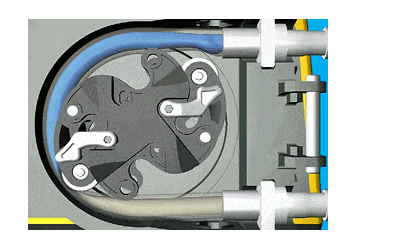
Pump head → Applying force
Hose → Deformation and rebound
The two work together to achieve delivery.
2.Why will the hose inevitably wear out?
Because it is constantly subjected to repeated deformation.
With each rotation of the peristaltic pump, the hose undergoes multiple compressions and rebounds. The longer the operation and the higher the rotation speed, the more frequent this cycle becomes. This continuous mechanical action causes the hose to gradually change its condition:
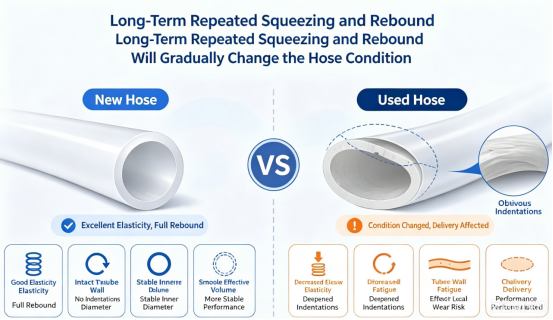
These changes may not be visible to the naked eye, but they are enough to affect actual delivery. Therefore, a hose isn't unusable only when it's broken!
It's like a rubber band being repeatedly stretched; initially, it can return to its original shape, but with repeated use, its elasticity gradually decreases.
3.What factors affect hose replacement frequency?
There's no fixed answer to how long a hose can last; it's closely related to actual operating conditions. Generally, the following factors affect hose wear:
① Operating time and speed:
The faster the pump rotates and the longer the operating time, the more times the hose is compressed.
② Actual operating conditions:
Long pipelines, high resistance, or the presence of valves, filters, etc., in the system can all increase the delivery burden.
③ The liquid itself:
Different liquids have different effects on hoses. Viscosity, corrosiveness, temperature, etc., all affect hose condition.
④ Compression method:
This is the most easily overlooked but crucial factor.
In most rotary peristaltic pumps, the hose needs to be repeatedly "compressed and released," a process that keeps the hose in a state of high-intensity deformation for extended periods.
4. The Cost of Replacing Tubing is Never Just About a Single Tubing
Replacing a single flexible tube seems simple.
However, in practice, tubing replacement is often more complex than simply "removing and reinstalling." Especially in automated equipment, continuous production, or quantitative dispensing scenarios, tubing replacement can also mean:
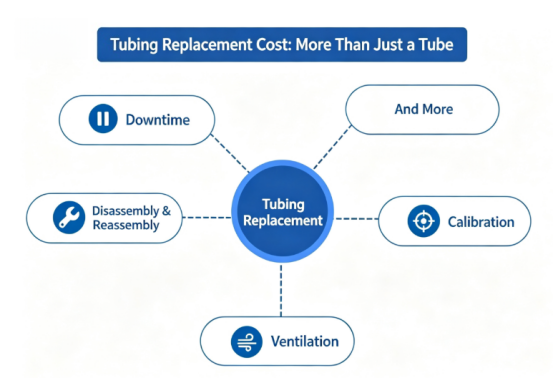
If tubing replacement is frequent, these actions will occur repeatedly.
On the surface, it seems like only one tube is being consumed;
In reality, it also consumes time, manpower, and system stability.
Reducing the frequency of tubing replacement is not essentially about "saving a tube," but about making the entire fluid transfer system more manageable.
5.So, can we reduce the number of hose replacements?
Yes, we can approach it from two directions.
Direction 1: Choosing the Right Hose
Based on the liquid properties, flow range, operating time, and operating environment, select a hose that matches the medium, pump head, and operating conditions.
Direction 2: Reducing Unnecessary Over-Compression
While ensuring delivery, reduce the mechanical load on the hose. In traditional solutions, complete closure is a "highly deterministic" design, but it also leads to continuous mechanical fatigue.
Therefore, a new approach is:
While meeting delivery requirements, can we reduce the excessive compression on the hose?
The LABONE squeeze pump is designed based on this idea:
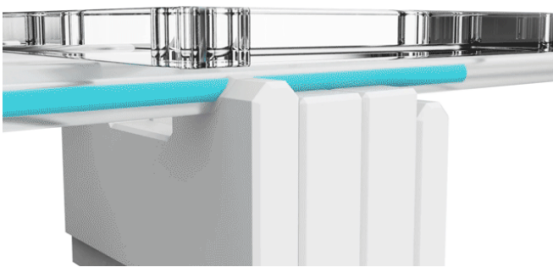
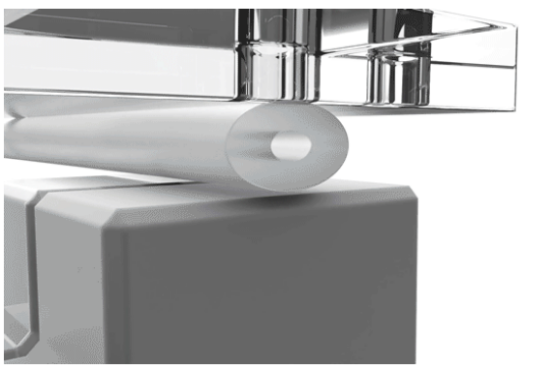
It uses a partially closed pipe method controlled by a "dual-valve structure + intermediate pressure block" for delivery. This approach brings changes including:
Reducing the mechanical load from repeated strong compression of the hose;
Reducing disassembly and downtime caused by frequent hose replacements;
Reducing the need for readjustment and calibration due to hose replacements;
Avoiding abnormal hose wear and the potential risks associated with it.
For applications requiring long-term, continuous, and stable delivery, this design offers a more convenient approach.
Of course, the specific solution still needs to be selected based on actual operating conditions. Flow rate, pressure, liquid properties, and system structure all affect the final result. However, from a long-term usage perspective: reducing unnecessary compression essentially extends the system's stable operation period.
Q:Why do peristaltic pumps always require tubing replacement?
Because the tubing is both a fluid conduit and a working component subjected to repeated stress. While offering the advantage of non-contact delivery, it also naturally bears the burden of fatigue, wear, and performance changes.
LABONE squeeze pumps address this fundamental issue by using a partially closed squeezing method to reduce the burden on the tubing, resulting in more stable and worry-free fluid delivery.
Continuously understanding the field and continuously improving technology—this is the essence of LABONE's professional brand philosophy, which insists on product innovation focused on real user problems.